
Random cans with no plan
A few cans of this and that, bought on sale, that never add up to actual meals.
A practical pantry system from The Retired Grocer
A step-by-step system that shows you what to buy, how much to keep, how to rotate it, and how to build your pantry gradually on a real household budget.
If you have ever stood in the canned-goods aisle wondering how much is enough, you are not alone. These are the problems that come up again and again.
A few cans of this and that, bought on sale, that never add up to actual meals.
Cases of something that seemed sensible at the time, still sitting there years later.
Is it ten cans or fifty? Without numbers, it’s easy to buy too little of what matters and too much of what doesn’t.
New groceries go in front, old ones get pushed back, and the oldest food is found when it’s too late to enjoy it.
One big stock-up trip strains the budget, and everything bought that day ages on the same schedule.
Big plans, giant containers, and not yet a week of meals that work when the power goes out.
The guide replaces guesswork with a short list of decisions you can actually make.
Each part answers one practical question.
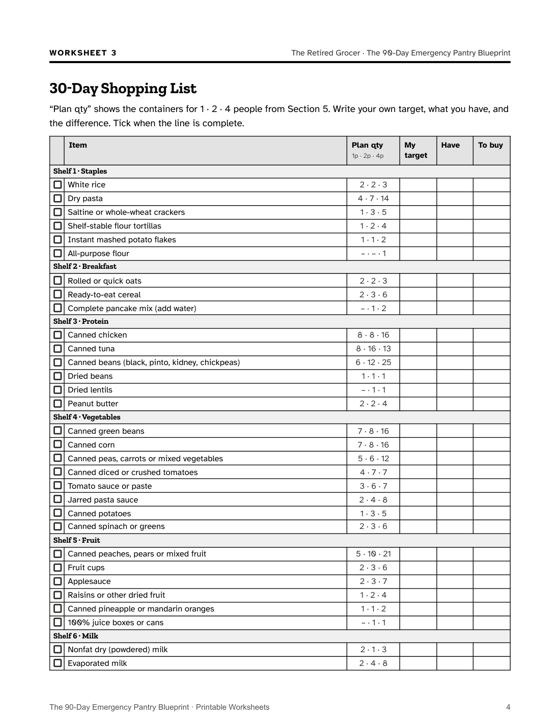
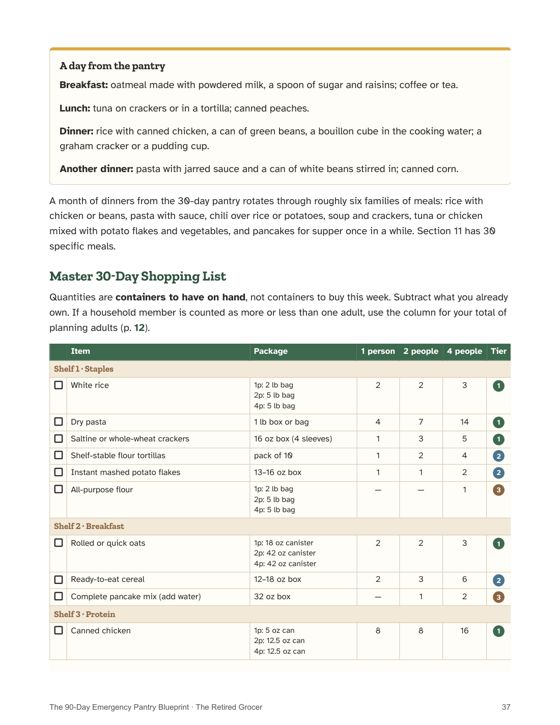
Shows you exactly which foods and how many containers make a month of ordinary meals, plus what to buy first if money is short.
Tells you what to add once your 30 days are in place, so the second month isn’t the first month repeated.
Splits the full list into three buying rounds: essentials first, variety second, comfort foods last.
Gives you planning quantities for 1, 2 and 4 people, and a simple calculator for any household, from a small appetite to a hungry teenager.
Helps you tell “past its best” from “unsafe,” using USDA storage data, and shows the warning signs that mean a can should go.
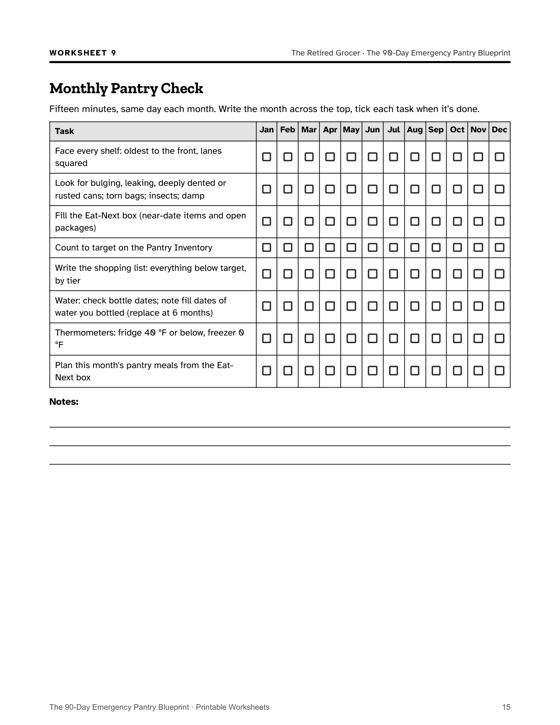
Keeps the oldest food moving to the front and getting eaten, with about fifteen minutes of checking a month.
Lets you build gradually at $10, $25 or $50 a week, or with one extra item per shopping trip.
Turns stored food into 30 real meals, sorted by what you can cook with that day.
Sorts every food into four tiers so you always know what to put in the cart next.
Walks you through the first 48 hours without power: what to eat first, what to keep cold, and what to throw out.
Works out how much water your household needs for 3, 7 and 14 days, and how to store it properly.
Gives every food a target and a count, so your shopping list writes itself.
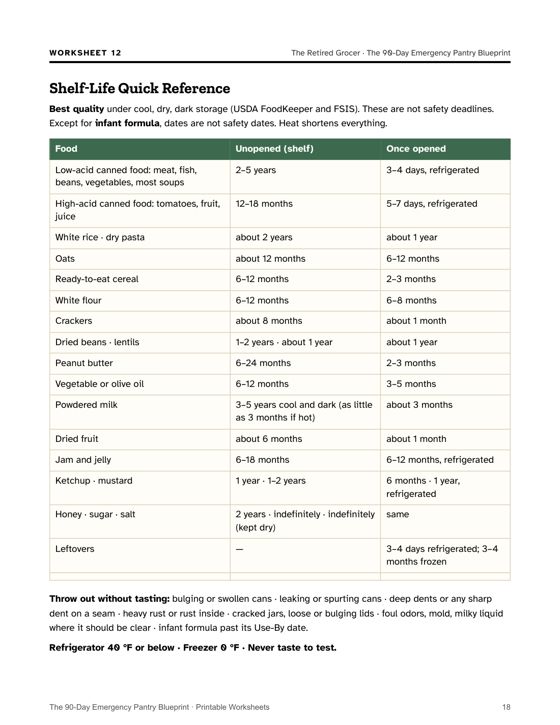
Where the safety information comes from. The food-safety, storage and water guidance in the guide comes from USDA, FDA, CDC, EPA, Ready.gov and university extension services, and each source is listed in the back of the book.
You do not need to buy 90 days of food this weekend. The guide builds your pantry in four steps, and everything you buy at one step counts toward the next, so nothing is wasted by starting small.
Start with the food you already eat. The guide begins with a ten-minute look at what’s already in your cupboards, then reduces every list by what you have.
A pantry you rotate isn’t an extra expense forever. You are buying food you would eat anyway, just a little earlier. The guide shows you what to buy first so every dollar adds a useful meal.
One extra
Add one item from the priority list to every normal shopping trip. No special trips, no big bills.
$10/week
Builds the 7-day buffer first, starting with the foods that need no cooking.
$25/week
The buffer within weeks, then the 30-day pantry one priority line at a time.
$50/week
A 30-day pantry in a couple of months, then steady progress toward 60 days.
| Goal | At $10 a week | At $25 a week | At $50 a week |
|---|---|---|---|
| 7-day buffer | about 8 weeks | about 3 weeks | about 2 weeks |
| 30-day pantry | about 31 weeks | about 13 weeks | about 7 weeks |
These are examples, not promises. They use USDA’s August 2026 Thrifty Food Plan cost estimate for an adult aged 51–70 living alone as a benchmark. Your store, your brands, and the food you already own will change them. The guide shows you how to price your own list.
Grocery stores rotate their shelves every day. The guide puts the same habit into a home routine called Front Row, Back Row:
The guide includes 30 practical meal combinations, sorted by what you can cook with that day: no-cook, one-pot, low-water, power-available and power-outage. They’re ordinary pantry meals, not a gourmet cookbook.
No-cook
A can of tuna, a sleeve of crackers, a can of fruit. No stove, no water.
One-pot
Two cans of beans, tomatoes, corn and chili powder. The can liquids are enough, so it needs no extra water.
Low-water
Pasta simmered in jarred sauce with about 1½ cups of water instead of a big pot.
Power outage
Quick oats and peanut butter with water boiled once on an outdoor stove.
Power outage
Instant potato flakes, canned chicken and corn, with only boiled water needed.
Power available
The cheapest dinner on the list, for the long stretch when the stove works.

Frank started bagging groceries in his father’s store at fourteen and ran the family store for decades after. His working life was inventory: ordering, pricing, canned goods, markdowns, spoilage, and watching what families really bought when money was tight or a storm was coming.
The lesson behind this guide is simple: buy what gets used, store it properly, rotate it, and don’t confuse bulk buying with preparedness.
Frank shares grocery reasoning, not medical or nutrition advice. The safety guidance in the guide comes from the government and university sources it cites.
The main guide
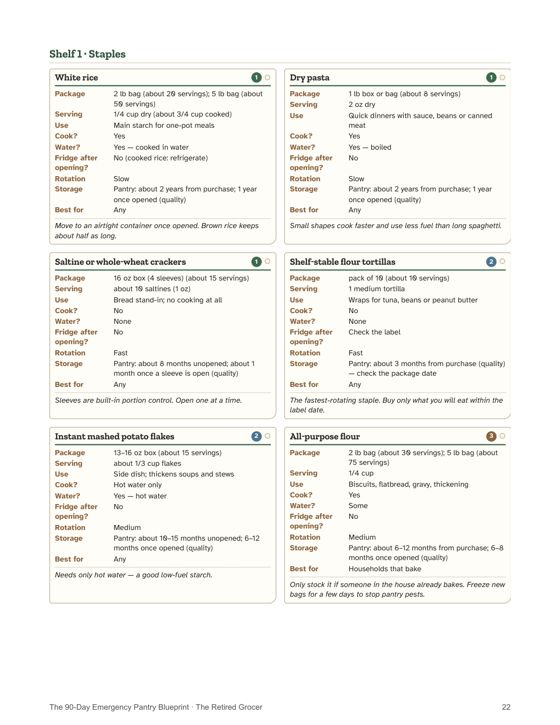
A 122-page printable PDF with large, easy-to-read type. It covers the 7-, 30-, 60- and 90-day plans, the Ten-Shelf Pantry, a master food list, the shelf-life reference, the rotation system, budget plans, 30 meals, the power-outage plan, water planning and adjustments for special diets.
Plus the printable worksheet pack: 18 worksheets
Designed to print clearly in black and white on standard US Letter paper. Print them as often as your household needs.
Bonus 1
For a household starting from an empty cupboard: how to split $100 across the shelves, and an example basket to shop in order until the money runs out.
Bonus 2
Fifty foods that earn their space in most households, each with a one-line reason why.
Bonus 3
From storing food in the garage to forgetting the can opener. Each mistake comes with a simple fix.
Bonus 4
No fresh milk, meat, bread or onions? The chart lists practical pantry swaps that work in everyday cooking.
Every plan has a one-person column that uses small cans and single servings, so you aren’t left with leftovers you can’t finish.
The guide shows how to fit a 30-day pantry into a closet shelf, a cabinet and under-bed bins.
The budget plans start at $10 a week or one extra item per trip. The priority list puts the most useful foods first.
Good. The first step is a ten-minute assessment, and every list is reduced by what you already have.
You won’t. The plans use ordinary grocery-store food: rice, pasta, canned goods, oats, peanut butter.
There are planning questions for allergies, gluten-free, low-sodium, vegetarian and diabetic households. The guide doesn’t prescribe diets; it helps you stock the diet your clinician has already approved.
The guide gives a clear first step for people living alone, couples, families and anyone on $25 a week, and a day-by-day action plan.
That’s what the rotation system is for: date it, eat from the front, check monthly, replace what you use.
$37one-time purchase
Checkout is not connected yet. The page owner needs to set the checkout link.
Digital product. Please review the product details before purchasing.
No. It’s a digital download: a PDF guide and a PDF worksheet pack. You can read them on a screen or print them at home.
No. The guide is written for ordinary households who want a sensible food buffer, not survival gear.
No. Every plan has quantities for one person, two people and four people, plus a calculator for any household size.
It gives planning quantities and adjustment guidance based on household size and how many days you’re preparing for. It also explains how to adjust for smaller or larger appetites.
Yes: where to keep food, temperature, moisture, pests, small spaces, and how long foods keep their best quality.
Yes. It includes a water calculator for 3, 7 and 14 days, container and storage guidance, and treatment steps taken directly from CDC and EPA guidance.
It includes 30 practical meal combinations, not a gourmet cookbook.
No. If someone in your household has a medical diet, the guide helps you stock the diet your doctor or dietitian has already approved.
Yes. They’re designed for black-and-white printing on US Letter paper, and you can print them as often as your household needs.
Yes. There’s a section on building a 30-day pantry in an apartment.
No. Everything on the lists is ordinary grocery-store food.
You do not need to buy everything at once.
You just need to know what to buy next.
$37 · Instant digital download · Printable worksheets included